
-
Implementation details for your ISO 20022 migration
ISO changes on account information messages
Overview camt.05X messages
Camt.05X messages are part of the ISO 20022 standard for bank-to-corporates financial messaging. They provide detailed account information, helping businesses and financial institutions reconcile transactions efficiently. This message standard is commonly used in corporate banking for cash and liquidity management.
The account information camt.05X message set includes three different message types, with each serving distinct financial reporting needs. Combined, these messages enable efficient cash flow monitoring, transaction tracking and financial control across treasury operations.
CAMT.053 is an end of day account statement which provides a detailed overview of account transactions for a particular booking day after business day closure. It enables businesses to reconcile transactions that happened throughout the day and helps with effective treasury management. It is a replacement for MT940 (End of day account statement).
Key benefits:
- End of day summary with detailed transaction information
- Supports daily reconciliation in ERP and TMS for better cash management
- Useful for corporates to analyze cash flow and track financial performance
CAMT.052 is an intraday account report which provides intraday updates on account transactions once they are booked. It enables businesses to monitor cash movements throughout the day and helps manage liquidity effectively. It is a replacement for MT942 (interim transaction report).
Key benefits:
- Provides intraday visibility into cash flows
- Supports corporate treasury operations for better cash management
- Useful for corporates with high transaction volumes needing frequent updates
CAMT.054 is a transaction level report which provides overview on Bulk booking transactions (batch payments) and R-transactions (return, rejects, refunds) for a particular booking day after business day closure. It enables businesses to reconcile credit and debit advices, batch bookings and return transactions that happened throughout the day and helps with effective treasury management.
Key benefits:
- End of day summary with detailed information on batches and returns
- Supports daily reconciliation in ERP and TMS for better cash management
- Useful for corporates to analyze cash flow and track financial performance.
The cash management messages listed above are provided via the following Deutsche Bank channels:
| Format | Channels available |
|---|---|
| camt.052 (Intraday account report) | EBICS, Host-to-Host, SWIFT Fileact, Cash Manager, API |
| camt.053 (End of day account statement) | EBICS, Host-to-Host, SWIFT Fileact, Cash Manager, API |
| camt.054 (Debit/credit advice, Bulk and return reports) | EBICS, Host-to-Host, SWIFT Fileact, Cash Manager, API |
Show content of What are the general differences between MT940 and ISO cam.053 messages?
| Description | MT940 | camt.053 V08 |
|---|---|---|
| Message structure | Flat text-based format with fixed tagged fields | ISO 20022 XML uses structured XML elements with clear definitions |
| Field length | Restricted character length, often truncated details | Larger field sizes due to the structured nature of the data elements |
| Data richness | Limited multilanguage support and limited reference fields | Supports Unicode, multiple languages, and extended remittance data. Full standardized references such as E2E ID, Transaction ID etc. |
| Bulk booking details | Bulk booking details are not supported | Bulk booking details are supported and can also be reported in a separate camt.054 message |
| Bank Transaction Code | Only GVO and SWIFT codes are supported | ISO Bank Transaction Codes (Domain/Family/SubFamily), SWIFT and GVO codes are supported. Provides more granularity |
Show content of What are the changes clients will be faced with during the migration?
With the transition to ISO 20022 and camt-based account statements, you will notice several important enhancements and adjustments designed to improve your daily processes:
- Richer transaction details. camt statements provide extended remittance information and structured data elements, giving you a complete picture of every transaction. This means fewer follow-up queries and faster identification of incoming and outgoing payments.
- Larger file sizes. camt.05x messages contain significantly more data than legacy MT formats, which means file sizes will be larger. This is a natural result of the enhanced detail and structure.
- Separate bulk booking reports. Bulk booking details can be provided in a camt.053 message or in a separate camt.054 message –a feature not possible with MT messages –offering clearer segregation of bulk transactions.
- Enhanced reference and transaction codes. camt.05x messages include additional reference details and bank transaction codes, giving you more flexibility and precision in your reconciliation processes
Show content of What are the benefits of an account statement based on ISO message format?
- The financial world is moving toward greater transparency, efficiency, and automation – and ISO 20022 is at the heart of this transformation.
- Improved reconciliation. With standardised and structured fields, camt messages simplify automated matching in your ERP or treasury systems. This reduces manual intervention, minimizes errors, and accelerates your reconciliation process.
- Regulatory readiness and futureproofing. ISO 20022 is the global standard for financial messaging. Migrating now ensures compliance with evolving regulatory requirements and positions your business for future innovations in payments and reporting.
- Multi-language and multi-currency support. Camt messages are designed for global business. They seamlessly handle multiple languages and currencies, making them ideal for multinational corporations and cross-border operations.
- Reduced ambiguity. Every data element in a camt message is clearly defined through XML tags. This eliminates interpretation issues common in legacy formats and ensures consistent processing across systems and geographies.
Show content of What do you need do to start your migration to ISO 20022 CAMT messages?
- Migrating from MT940 to camt.053 V08 is more than a format change – it’s an opportunity to enhance reconciliation, data richness, and compliance. Here’s how to get started:
- Review system capabilities. Ensure your ERP or TMS can parse ISO 20022 XML and supports Unicode. This is essential for handling structured data and multi-language content.
- Update technical Integration and review capabilities. Adjust your mapping from MT940 tags to camt.053 XML elements. This step ensures seamless data flow between the technical systems and your bank.
- Test and validate. Run MT940 and camt.053 in parallel during a coexistence phase to confirm accuracy and consistency. Use SWIFT MyStandards guidelines and sample messages for format testing.
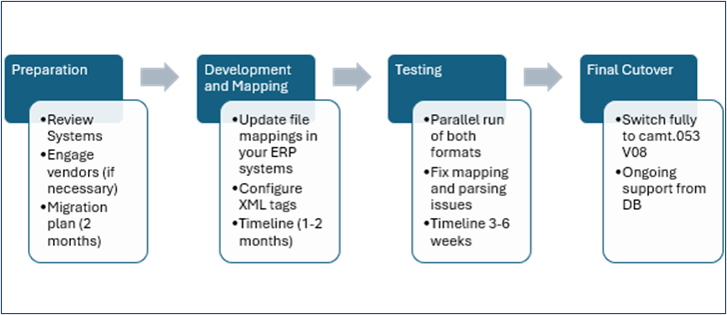
Please prepare your transition by testing, in coordination with treasury, IT, your banking partners and TMS Service providers. This will assist and lead to a smooth ISO migration.
The format guidelines for the different message types as well as the sample files are available on Swift MyStandards via dbAutobahn. Please ask your service contact at Deutsche Bank if you need further details. If you need more time for your individual analyses and preparation of your IT system for future processing, please request a coexistence phase of MT and camt message to take your time to decide about individual ISO migration path.
Disclaimer
This factsheet is for information purposes only and is designed to serve as a general overview regarding the services of Deutsche Bank AG, any of its branches and affiliates. The general description in this factsheet) relates to services offered by Corporate Bank of Deutsche Bank AG, any of its branches and affiliates to customers as of July 2026, which may be subject to change in the future. This information is provided solely as a neutral description of operational capability and is not a recommendation or marketing of any booking location or structure. Cash management accounts are generally available to locally established or resident entities and, within the EEA, to entities established in other EEA jurisdictions. Non-resident accounts for clients outside the relevant jurisdiction (including outside the EEA) are restricted and will only be provided where independently and exclusively initiated by the client, without any prior or contemporaneous marketing, promotion, or solicitation by the Bank or its affiliates, and subject to applicable legal and regulatory requirements. This factsheet and the general description of the services are in their nature only illustrative, do neither explicitly nor implicitly make an offer and therefore do not contain or cannot result in any contractual or non-contractual obligation or liability of Deutsche Bank AG, any of its branches or affiliates. Deutsche Bank AG is authorised and regulated by the European Central Bank and the German Federal Financial Supervisory Authority (BaFin). With respect to activities undertaken in the UK, Deutsche Bank is authorised by the Prudential Regulation Authority. It is subject to regulation by the Financial Conduct Authority and limited regulation by the Prudential Regulation Authority. Details about the extent of Deutsche Bank AG’s authorisation and regulation by the Prudential Regulation Authority are available from Deutsche Bank AG on request.
Copyright© (July 2026) Deutsche Bank AG. All rights reserved.