
-
Implementation details for your ISO 20022 migration
Payment address data requirements
What companies need to know
Structured address data in payment transactions
The ongoing introduction of the ISO 20022 standard is bringing significant changes to international and urgent payments.
A key change concerns the mandatory use of structured or hybrid address data in payment instructions whenever an address is provided. Proactive modifications to your ERP and TMS systems are required to support efficient and compliant payment processing as market practices evolve.
Show content of Which payment instruments are affected?
%%%active
The following cases require the provision of address information comprising, at a minimum, the town name and ISO country code:
- International payments (for the beneficiary, the ultimate payer and the ultimate beneficiary and the agents along with the local clearing code if no BIC is provided)
- SEPA direct debits, where payer address information is mandatory if part of the transaction occurs outside the EU/EEA. For ultimate payer and ultimate beneficiary, address information is not permitted.
Attention: Countries/regions (jurisdictions) may define deviating regulations for domestic transactions, e.g. addresses are not required in United Kingdom for domestic credit transfers and direct debits; addresses are not required for urgent payments within EU/EEA in EU/EEA currency; addresses are not required for SEPA direct debits within EU/EEA nor SEPA credit transfers.
Deutsche Bank applies the orderer’s name and, if required, address from customer master data to provide them in the outbound clearing message.
Rule: Once a postal address is provided, town name and ISO country code must be included in dedicated elements. This rule is valid for international payments across the globe, all SEPA transactions, and those urgent domestic payments where the payment market infrastructure follows the ISO postal address requirements, e.g. T2, CHAPS for UK, SIX for Switzerland.
Most domestic non-urgent payments don’t require structured or hybrid postal address data.
Show content of Background and relevance of structured addresses
ISO pain messages (versions 03 and 09) contain dedicated data elements (XML fields) such as street name, building number, floor, postal code, town name and country. The adoption of structured address data supports improved data quality, enhanced automation, and compliance with applicable regulatory requirements, including those related to the prevention of financial crime.
In addition to the mandatory town name and country, we strongly recommend including the postal code (if available) and additional address details such as street name and building number, each in its designated element. To support accurate identification of all parties involved in a payment, which is relevant for customer due diligence and transaction monitoring processes, address information should be provided in dedicated elements whenever possible. Whilst unstructured beneficiary addresses (i.e., using only address lines) are still accepted until November 2026, clients are therefore encouraged to migrate to structured or hybrid formats well in advance of this deadline.
Show content of Requirements for pain.001 v03 and v09, as well as pain.008 v02 and v08
- From 14 November 2026, in line with current market timelines, addresses for payments are expected to be provided in a hybrid or structured format rather than solely as unstructured address lines.
- Since November 2025, international and urgent payments involving an ultimate payer or ultimate beneficiary (i.e., 'on behalf of' payments) have required addresses to be submitted in structured or hybrid format.#
What address options are available?
Address Option 1 – Structured address
By providing the address information exclusively in the dedicated XML elements, the fully structured address format offers the highest level of detail. For example, the building number should be put in a separate data element to avoid potential future payment rejections. In this fully structured option, no address line is included.
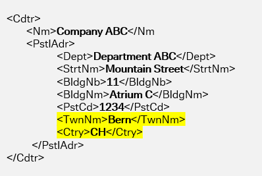
The use of fully structured address information may reduce the likelihood of payment interventions during transaction or sanctions screening processes, thereby supporting more efficient processing.
Address Option 2 – Hybrid address
If you cannot provide part of the address information in dedicated XML elements (e.g., separating street name and building number), this information may be provided in a maximum of two address lines. This hybrid address option combines unstructured and structured address data in a pragmatic manner. Town and country are mandatory dedicated data elements and should not be repeated in the address lines if already provided.
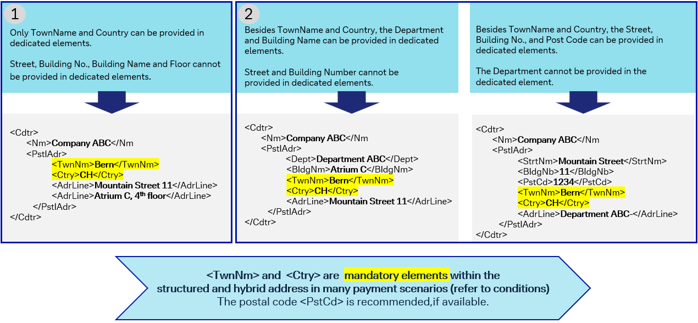
Show content of What actions need to be taken?
We recommend prioritising the following actions to ensure a smooth transition:
- Begin with a comprehensive review and revision of your address master data and the process by which your business partners’ address data is stored in your systems.
- Ensure that, from the outset, the fully structured or hybrid structure is applied when providing an address, including the mandatory data elements town name and country. This applies to the payer, the beneficiary, as well as any ultimate payer or ultimate beneficiary.
Show content of Support from Deutsche Bank
Both the fully structured and hybrid address options are supported in pain.001 messages versions 03 and 09, as well as pain.008 messages versions 02 and 08. Where beneficiary address information does not meet applicable clearing requirements, Deutsche Bank may apply adjustments solely to support onward payment processing, subject to market constraints.
With respect to address details of the ultimate payer or ultimate beneficiary, town name and country must already be provided in dedicated data elements. Deutsche Bank will accept address data without rejecting payments on this basis.
In case of agents, if BIC is provided then address data validation (town name and country code) is not performed.
However, the transmission of all address elements to the recipient bank may depend on downstream processing capabilities within the wider payment chain as part of the ISO 20022 migration.
Show content of Important details on data processing in the payment process
- Currently, the semantic consistency of address data elements (for example, whether the town name corresponds to the provided country), is not systematically validated as part of payment processing.
- For smooth payment processing, the town name should be in English or the recipient country's language using Latin characters.
- The name and address of the payer are supplemented from Deutsche Bank’s master data. For the beneficiary bank or correspondent bank, it is advisable to use the SWIFT BIC. If this is not available and the local clearing code is applied, then the bank name and bank address (town name and country) must be provided.
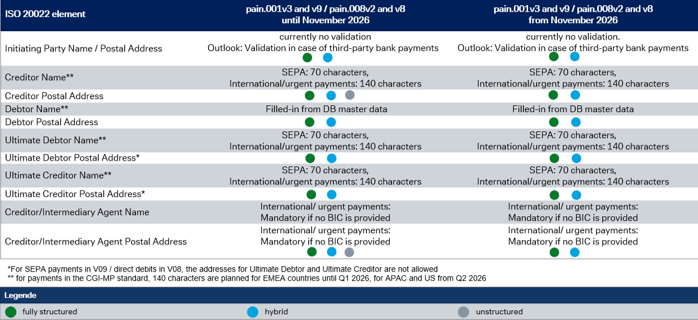
Show content of Reference to format specifications
Disclaimer
This factsheet is for information purposes only and is designed to serve as a general overview regarding the services of Deutsche Bank AG, any of its branches and affiliates. The general description in this factsheet) relates to services offered by Corporate Bank of Deutsche Bank AG, any of its branches and affiliates to customers as of July 2026, which may be subject to change in the future. This information is provided solely as a neutral description of operational capability and is not a recommendation or marketing of any booking location or structure. Cash management accounts are generally available to locally established or resident entities and, within the EEA, to entities established in other EEA jurisdictions. Non-resident accounts for clients outside the relevant jurisdiction (including outside the EEA) are restricted and will only be provided where independently and exclusively initiated by the client, without any prior or contemporaneous marketing, promotion, or solicitation by the Bank or its affiliates, and subject to applicable legal and regulatory requirements. This factsheet and the general description of the services are in their nature only illustrative, do neither explicitly nor implicitly make an offer and therefore do not contain or cannot result in any contractual or non-contractual obligation or liability of Deutsche Bank AG, any of its branches or affiliates. Deutsche Bank AG is authorised and regulated by the European Central Bank and the German Federal Financial Supervisory Authority (BaFin). With respect to activities undertaken in the UK, Deutsche Bank is authorised by the Prudential Regulation Authority. It is subject to regulation by the Financial Conduct Authority and limited regulation by the Prudential Regulation Authority. Details about the extent of Deutsche Bank AG’s authorisation and regulation by the Prudential Regulation Authority are available from Deutsche Bank AG on request.
Copyright© (July 2026) Deutsche Bank AG. All rights reserved.